

In this article



Back to blogs
Articles
April 20, 2026
·
8 min read
Why Public Safety Organizations Are Rethinking Their Communications Infrastructure

Why Public Safety Organizations Are Rethinking Their Communications Infrastructure
A guide for sales, advisory, and technology teams navigating mission-critical connectivity conversations with emergency services leaders.
Reliable communications in public safety is no longer a hardware question. It is a resilience architecture question. Police, fire, and EMS leaders increasingly find themselves managing a gap between what their networks are expected to do during an active incident and what commercially available infrastructure was actually built to handle. The environments that matter most—dense urban areas, remote terrain, disaster-impacted infrastructure, high-rise buildings—are precisely the environments where standard carrier-grade LTE is most likely to underperform.
The consequences of that gap are not abstract. Dropped communications during an active incident, a dispatch link that fails when a cell tower is overwhelmed, a command vehicle that loses connectivity in a terrain dead zone—these are not IT problems. They are operational failures with life-safety implications.
This article is designed to help sales, advisory, and technology teams frame that conversation with public safety decision-makers by focusing on three central questions:
- What are public safety communications managers actually most worried about right now?
- Where do coverage and reliability failures typically originate in the field?
- Why do single-vendor or single-carrier approaches keep falling short of operational requirements?
How to Start the Conversation
Instead of opening with a product, modern conversations with public safety leaders begin with operational risk and incident readiness. The leaders who make connectivity investment decisions in this sector are not IT generalists. They are people who have experienced the consequences of a failed radio, a dead zone in the field, or a command network that went down at the worst possible moment. They do not need to be convinced that connectivity matters. They need to be convinced that you understand what their connectivity requirements actually are—and that your solution was designed with those requirements in mind, not adapted to them after the fact.
Mission-critical communications resilience—the ability to maintain command, dispatch, and field coordination during an active incident, regardless of what is happening to the surrounding infrastructure—is the foundational operational priority. That shifts the conversation away from carrier comparisons and toward architecture:
- From “Do we have coverage?” to “Does our coverage hold when everything else around us is failing?”
- From “Are we on LTE?” to “What happens when the tower is overloaded or physically compromised?”
- From “What carrier do we use?” to “How many independent network paths does our most critical vehicle have, and how quickly does it switch between them?”
- From “Did we test the system?” to “Did we test the full failure scenario, under real conditions, at scale?”
For public safety organizations, this framing is especially powerful because the leaders you are speaking with already understand operational consequence. They do not need to be told that downtime is bad. They need to understand that your architecture was specifically designed to eliminate the failure modes they have already experienced or are most afraid of. Positioning the discussion around redundancy depth, failover verification, and guaranteed coverage in environments where coverage gaps are historically most likely makes the conversation concrete, credible, and relevant.
What Public Safety Communications Leaders Are Really Worried About
In practice, public safety communications managers are not shopping for a single missing feature. They are concerned about architectural resilience, operational continuity under stress, and the gap between what their current infrastructure promises and what it delivers when it is actually needed.
1. Coverage in the Environments That Matter Most
Terrain, building density, underground infrastructure, and disaster-damaged carrier equipment all create the exact conditions where coverage is needed most and where single-carrier LTE is most likely to fail. A patrol vehicle that loses connectivity driving through a rural corridor, a fire apparatus that loses radio coverage in a basement, a command post that goes dark because the local tower is damaged in the same event they are responding to—these are not edge cases. They are predictable failure scenarios that every public safety communications manager has either experienced or plans for.
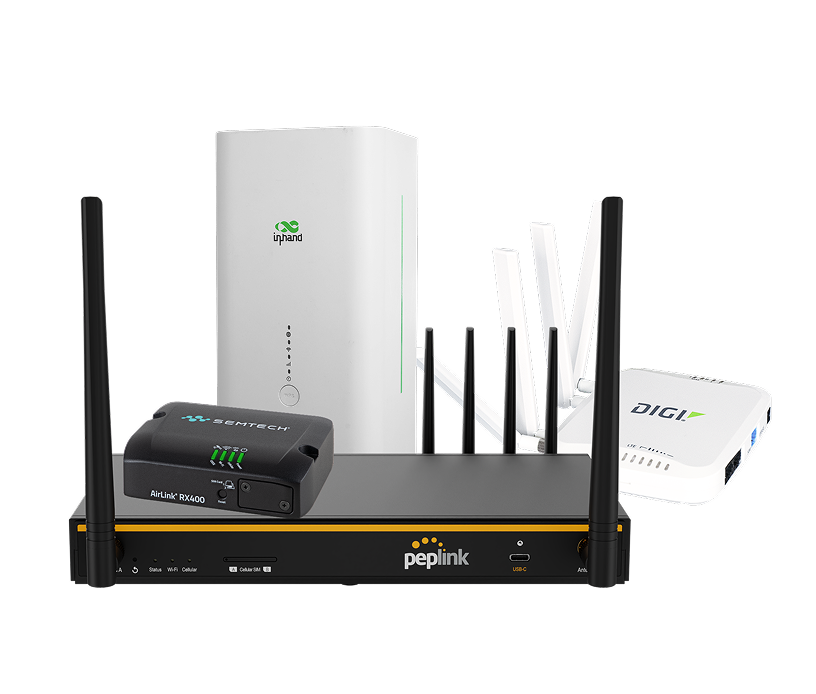
Purpose-built rugged cellular routers with multi-carrier SIM bonding address this by connecting simultaneously to every available network—not sequentially after a failure event. The difference is not marginal. Sequential failover adds latency and a gap. Simultaneous multi-carrier bonding with SpeedFusion technology means the device is already on the best available path before any single carrier degrades. Starlink integration extends this further, providing a satellite-based path in environments where all terrestrial carriers are unavailable or overloaded.
2. Failover That Is Assumed Rather Than Tested
Many public safety organizations have redundancy on paper. Fewer have verified it under real operational conditions. The gap between documented redundancy and tested redundancy is where most real-world failures occur. A secondary connection that has never been stress-tested, a failover configuration that was set up during initial deployment and never revisited, a backup path that shares underlying infrastructure with the primary—these are liabilities disguised as safeguards.
The standard for mission-critical communications is not “we have a backup.” It is “we have verified that our backup performs to specification under the exact conditions in which we would need it.” That means active failover testing, not just passive configuration. It means testing under load, testing in the field, and testing in degraded environments—not just in a controlled lab setting during the initial deployment.
3. The Latency Question and the Role of Digital Two-Way Radio
Most public safety organizations continue to rely on Motorola digital two-way radios as their primary voice coordination tool. There is a reason for this: the latency requirements for time-critical voice communication in emergency response are extremely low, and PTT over cellular—while improving—has historically introduced latency that is unacceptable in split-second coordination scenarios. The infrastructure conversation for public safety is therefore not about replacing digital radios. It is about building the resilient data and command infrastructure that sits underneath them.
Some US public safety organizations have begun moving toward PTT over cellular as a secondary or supplementary voice layer, particularly for situations where radio range would otherwise be a limiting factor. This is a meaningful development. But the primary message for public safety connectivity is about guaranteeing the data infrastructure—dispatch systems, GPS and location services, incident management platforms, camera and video feeds, and command coordination tools—never goes down, regardless of what is happening to the physical infrastructure around the response team.
Where Coverage and Reliability Failures Typically Originate
Understanding where failures actually occur—not just where they are theoretically possible—is essential for a credible infrastructure conversation with public safety decision-makers. The failure modes that matter most in this sector fall into three categories.
The first is single-carrier dependency. When a public safety vehicle or fixed command asset relies on a single carrier connection, the resilience of the entire communications stack is only as strong as that carrier’s coverage and uptime at any given moment. High-demand events—major incidents, natural disasters, public gatherings—are precisely the scenarios where carrier networks experience the most congestion and are most likely to degrade.
The second is untested failover architecture. Secondary connections that have never been stress-tested under real operational conditions provide a false sense of security. The architecture looks sound on paper, but the organization has no real evidence that it will perform when it is needed.
The third is geographic coverage gaps. Terrain, building construction, underground infrastructure, and the physical limitations of terrestrial LTE networks create predictable dead zones that are known to local responders but often not addressed at the infrastructure level. Starlink integration is the most significant development in addressing this failure mode, providing a genuinely independent, high-bandwidth path in environments where all terrestrial carriers are unavailable.
Why Conventional Solutions Keep Falling Short
Standard commercial connectivity solutions were not designed for public safety operational requirements. They were designed for business SLAs that tolerate some level of outage—a few hours per month, a planned maintenance window, an acceptable percentage of dropped calls. Public safety operations do not have acceptable outage windows. The architecture has to reflect that, and most commercial solutions do not.
Single-carrier managed service agreements, consumer-grade LTE routers, and standard business internet solutions all share the same fundamental limitation: they were designed around the assumption that some level of failure is acceptable. In public safety communications, that assumption is operationally unacceptable. The architecture that serves this market needs to be built around a different assumption entirely—that failure is not an option, and that every component of the design needs to reflect that requirement.
How to Turn This Into a Productive Conversation
For public safety communications decision-makers, the core challenge is not awareness of the problem. They know their infrastructure has gaps. The challenge is building the business case for a more resilient architecture—one that can be justified to administrators, procurement teams, and budget committees who may not have firsthand experience with the operational consequences of a communications failure.
The most productive sales and advisory conversations in this sector focus on:
- Operational consequence, not technical specification: Lead with what happens when the infrastructure fails, not with the specifications of the solution.
- Verified resilience, not documented redundancy: The distinction between having a backup and having a tested backup is one that every experienced public safety leader immediately understands.
- Total coverage architecture: Position the conversation around the complete coverage map—cellular, multi-carrier, Starlink—rather than around any single path or carrier.
- Infrastructure as the foundation: Frame the solution as the infrastructure layer that makes every other tool the organization uses more reliable, not as a replacement for existing systems.
Related articles
Keep reading

Articles
Beyond the Fibre Line: Three Teltonika Deployments and What They Mean for Canadian and U.S. Businesses
From remote energy sites to pop-up retail, see how Teltonika’s RUT241, RUT956 and RUTM50 routers solve real connectivity problems, and what it means for your operations in Canada and the U.S.
October 13, 2026
·
5 min read
Read Article

Articles
What Growing Businesses Get Wrong About Wireless Connectivity — And What It Is Actually Costing Them
Most growing businesses underinvest in connectivity until something breaks. This guide helps sales and advisory teams make the hidden cost of connectivity failures visible to mid-market leaders and frame the conversation around architecture, redundancy, and business continuity.
April 20, 2026
·
8 min read
Read Article

Articles
Why Retail and Hospitality Operators Are Consolidating Connectivity and Digital Signage Under One Provider
Fragmented technology relationships across multi-location retail and hospitality operations create more risk than they eliminate. This guide explores why operators are consolidating connectivity, digital signage, and network management under a single provider for brand consistency, operational control, and guest experience.
April 20, 2026
·
7 min read
Read Article

Technology advisory partner for mid-market and enterprise businesses across Canada.
©1999-2026 National Wireless All rights reserved.

Bell Canada is neither the owner nor the author of this Website, and it is in no way responsible for any of its contents or updates. As such, Bell cannot guarantee the accuracy or timeliness of the information presented in this site. The Bell logo is a trade-mark of Bell Canada, used under licence.
