

In this article



Back to blogs
Connectivity
September 30, 2024
·
9 min read
How to Choose a Cellular Router for Fleet Telematics Deployments

Fleet telematics is one of the most common IoT deployment types in Canada — and one of the most frequently done wrong. The hardware that performs reliably in a temperature-controlled IT room does not necessarily survive a Canadian winter in a heavy equipment cab, a utility truck working in northern Ontario, or a transit bus operating through freeze-thaw cycles.
This article is a practical guide to cellular router selection criteria for fleet telematics deployments, based on what we have observed across hundreds of fleet deployments in varying environments and use cases.
Start With the Environment, Not the Spec Sheet
The single most common mistake in fleet router selection is starting with the product catalogue and filtering by feature. The right starting point is a rigorous description of the deployment environment — because environmental constraints eliminate most options before features become relevant.
- Operating temperature range — Fleet vehicles in Canada regularly see temperatures from -40°C in winter to +70°C inside a cab in summer sun. The router’s rated operating temperature range is a hard constraint, not a marketing consideration.
- Vibration and shock — Heavy equipment, off-road vehicles, and commercial trucks subject electronics to continuous vibration and periodic high-G shock events. Look for MIL-SPEC ratings or documented vibration testing.
- Power supply stability — Vehicle power is not clean. Voltage spikes on startup, voltage sag under load, and ignition noise are all common.
- Physical size and mounting — The available installation space in a vehicle cab is often constrained. DIN rail mounting compatibility and compact form factors matter.
- External antenna ports — Not optional for serious deployments. Integrated antennas do not provide reliable signal in all vehicle orientations and environments.
Cellular Technology Requirements
LTE Bands and Carrier Compatibility
Not all LTE routers support all LTE bands. Bell’s primary LTE bands differ from Rogers’ and Telus’. A router tested and certified on your specific carrier is a meaningful distinction.
Dual-SIM Capability
For mission-critical applications — real-time dispatch, worker safety monitoring, or time-sensitive telemetry — dual-SIM capability with automatic failover between carriers is the correct architecture.
5G vs LTE
For most current fleet telematics applications, LTE provides more than sufficient bandwidth. The exception is applications requiring high-bandwidth real-time video streaming from vehicles.
Management and Integration
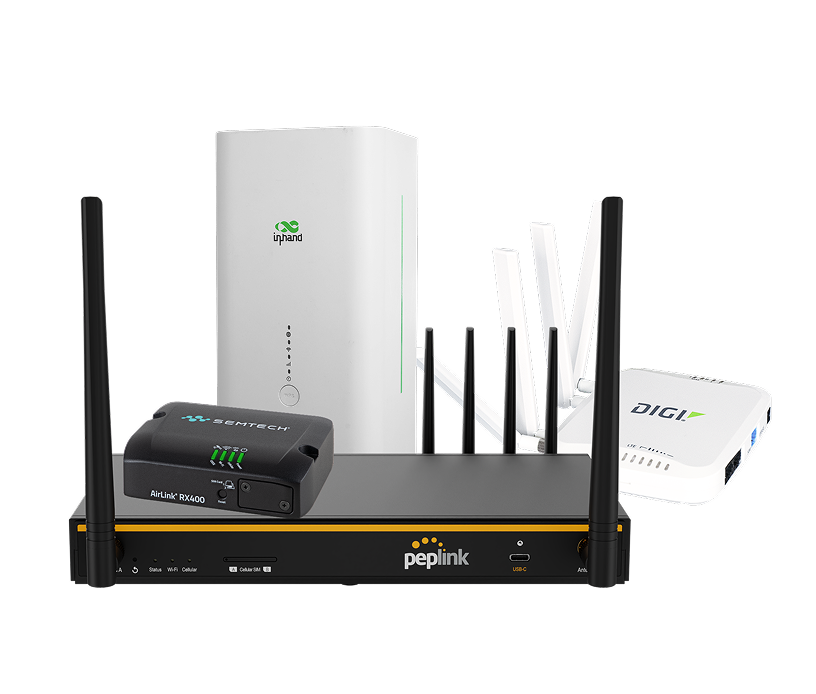
A fleet of 50 vehicles is not practically managed through on-device access. A cloud-based remote management platform is a basic operational requirement. Peplink’s InControl 2 and Teltonika’s RMS are both mature platforms with different strengths.
Matching Hardware to Use Case
- Light commercial vehicles, urban routes — Standard LTE router with single-SIM. Peplink MAX BR1 Lite or comparable.
- Heavy equipment, remote or safety-critical — Dual-SIM, ruggedised hardware. Peplink MAX BR1 Pro or Teltonika RUT956.
- Industrial vehicles with serial port needs — Teltonika RUT series with RS232/RS485 I/O.
- Mixed fleet with SD-WAN integration — Peplink with FusionHub integration.
Hardware selection is the start of a telematics deployment, not the end. The cellular configuration, management platform setup, and integration work that follows determines whether the deployment delivers its intended value.
Related articles
Keep reading

Articles
Beyond the Fibre Line: Three Teltonika Deployments and What They Mean for Canadian and U.S. Businesses
From remote energy sites to pop-up retail, see how Teltonika’s RUT241, RUT956 and RUTM50 routers solve real connectivity problems, and what it means for your operations in Canada and the U.S.
October 13, 2026
·
5 min read
Read Article

Articles
What Growing Businesses Get Wrong About Wireless Connectivity — And What It Is Actually Costing Them
Most growing businesses underinvest in connectivity until something breaks. This guide helps sales and advisory teams make the hidden cost of connectivity failures visible to mid-market leaders and frame the conversation around architecture, redundancy, and business continuity.
April 20, 2026
·
8 min read
Read Article

Articles
Why Retail and Hospitality Operators Are Consolidating Connectivity and Digital Signage Under One Provider
Fragmented technology relationships across multi-location retail and hospitality operations create more risk than they eliminate. This guide explores why operators are consolidating connectivity, digital signage, and network management under a single provider for brand consistency, operational control, and guest experience.
April 20, 2026
·
7 min read
Read Article

Technology advisory partner for mid-market and enterprise businesses across Canada.
©1999-2026 National Wireless All rights reserved.

Bell Canada is neither the owner nor the author of this Website, and it is in no way responsible for any of its contents or updates. As such, Bell cannot guarantee the accuracy or timeliness of the information presented in this site. The Bell logo is a trade-mark of Bell Canada, used under licence.
